

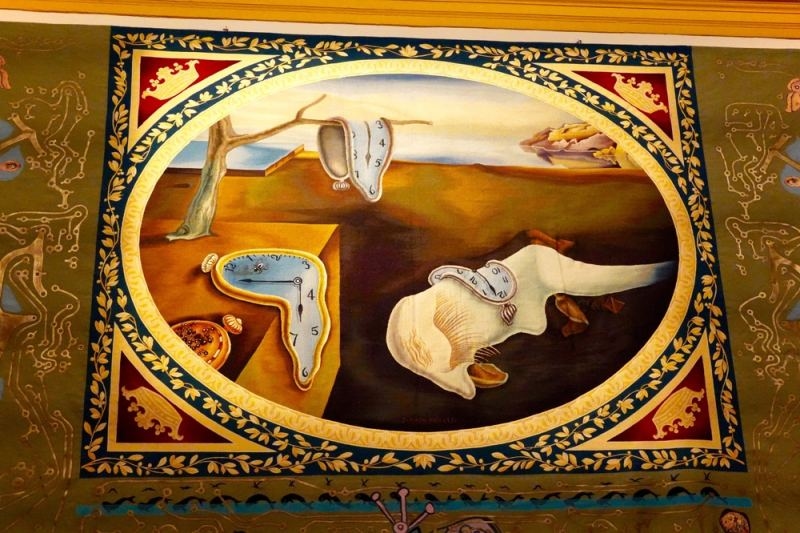
Stand in front of a Dalí painting long enough and something in your brain just short-circuits. That's kind of the whole point of surrealism — it never cared about copying the world, only about what happens when logic clocks out and the unconscious takes the wheel. The famous surrealist artists who built this movement spent decades chasing dreams, coincidence, and images that have no business sitting next to each other. Melting clocks, haunted self-portraits, pipes that swear they're not pipes — a hundred years later, this stuff still messes with people's heads.
You can trace the history of the surrealist art movement back to a fairly specific moment: 1924, when André Breton published his Surrealist Manifesto. Breton wasn't even a painter — he was a poet, and he was borrowing heavily from Freud's theories about dreams and everything buried in the subconscious. The goal was art that skipped rational thought entirely and went straight for whatever lay beneath.
It didn't just appear out of nowhere, though. Dada had already spent years tearing up the rulebook after World War I left everyone questioning what "civilized" even meant. Surrealists took that same rebellious streak and pointed it in a new direction, playing with automatic drawing and frottage to drag strange, buried imagery into the daylight. That's really where the movement's unsettling look comes from.
A small group of names basically defined this whole movement, and honestly, they couldn't have painted a more different picture of each other.
None of these six worked alone, either. They exhibited together, argued constantly about what "real" surrealism even meant, and stole ideas off each other the whole time.
Must Try: Famous Watercolor Artists and the Skill Behind Their Art
There's really no talking about Salvador Dalí's surrealism without mentioning The Persistence of Memory, painted in 1931. Those melting clocks became shorthand for the entire movement — plenty of people who've never set foot in a museum still recognize them instantly.
Dalí called his approach the "paranoiac-critical method," which sounds a bit much, and honestly kind of was. He'd deliberately push himself into a hallucinatory headspace, then paint whatever surfaced from it. That's a pretty different game from the one artists who leaned on pure chance or automatic drawing played.
He didn't stick to painting, either. Dalí worked with Alfred Hitchcock and even Walt Disney at one point, dragging surrealism straight into film. His theatrical persona and collaborations propelled Surrealism into mainstream consciousness, as the Artling puts it. Basically, he got surrealism famous outside gallery walls — something not many "serious" artists of his time ever managed.
For a long stretch, surrealism's story was told almost entirely through men. Which is a shame, because some of the movement's most interesting work came from women who kept getting pushed to the margins.
What these women brought — identity, the body, womanhood — just wasn't showing up in their male peers' work.
Surrealism didn't die out with Breton's generation. Modern surrealist artists have simply swapped in new tools — Photoshop, digital painting, AI — while keeping that same dream logic alive.
Erik Johansson builds gravity-defying scenes through photo manipulation that somehow still look real. Vladimir Kush does something similar with paint, merging objects into hybrids he calls "metaphorical realism." The movement never actually stopped. It just adapted.
And Instagram hasn't hurt, either — modern surrealist artists can reach millions overnight, something Dalí and Magritte never had access to.
A handful of surrealist artists' paintings have basically become cultural shorthand at this point, recognized even by people who've never cracked an art history book.
Also Read: Famous Impressionist Artists Who Left a Lasting Mark on Art
Surrealism's fingerprints are everywhere now — film, advertising, fashion, even the reality-warping filters people slap on selfies for fun. Directors like David Lynch and Guillermo del Toro have talked openly about how much Surrealist imagery shaped their work.
At its core, the whole movement made one simple argument: logic isn't the only road to truth, dreams count too. In a world drowning in images, that strangeness still manages to make people stop scrolling for a second.
André Breton is mostly credited as the founder of surrealism, having penned the original 1924 manifesto. He helped shape its philosophy through dream logic, automatism, and the unconscious mind, and, in a way, he stitched writers and painters together into one movement, even if it sometimes sounds a bit messy.
Surrealist paintings tend to mix a realistic, almost precise technique with illogical, dreamlike content. You’ll usually notice impossible scenes, warped objects, or symbolic imagery that feels pulled from dreams, meant to unsettle common, rational seeing and push you toward deeper psychological reflection.
Kahlo herself rejected the “surrealist” label, saying she painted her own reality rather than dreams. Still, critics link her symbolic, emotionally intense self-portraits to surrealist visual vocabulary and recurring themes, even when she didn’t claim the tag.
Dalí’s paranoiac-critical method and his entire theatrical persona helped bring surrealism into the broader public eye. Through collaborations with filmmakers plus designers, he extended surrealist thinking into cinema, fashion, and advertising far beyond the usual gallery walls, you know, in practical ways not just theory.
Yes, today’s artists keep the surreal spirit alive, often using digital tools, photography, and even AI to produce dreamlike, impossible imagery. People like Erik Johansson and Vladimir Kush continue that tradition while working with newer techniques and online platforms.
This content was created by AI