


Walk into any major gallery today, and things look very different than they did twenty years ago. The fine art world spent centuries operating like a private country club, deliberately shutting out anyone who didn't fit a very specific, wealthy European aesthetic. Museum curators held all the power and completely ignored entire communities.
But keeping people locked out only works for so long. A core group of black artists stopped waiting for gallery owners to validate them. They started documenting their own neighborhoods and histories using whatever materials they had on hand. Instead of begging for wall space, they forced the establishment to pay attention.
Must Read: Famous Abstract Artists Who Transformed Modern Art History
Mainstream art institutions ignored non-white creators for generations. These artists didn't alter their work to fit into that system; they made pieces so undeniable that the major galleries were forced to adapt.
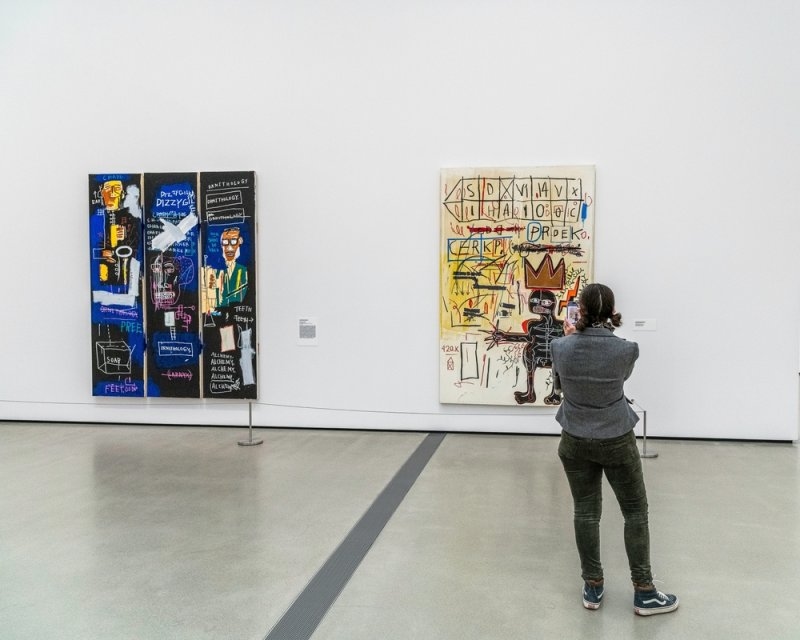
He moved from tagging NYC street corners and subway cars directly into elite gallery spaces. His paintings look frantic at first glance, but they mash together medical diagrams, jazz history, and sharp critiques of institutional power.
He chronicled Black history starting in the 1930s, long before mainstream institutions paid attention. His 60-panel Migration Series details the journey of southern Black families moving north using bold, flat colors and simple geometric shapes.
She ditched standard stretched canvas entirely. Instead, she painted on fabric and sewed it straight into massive quilts. This forced the art world to finally look at household sewing as a serious platform for civil rights protests and raw family memories.
She cuts silhouettes out of black paper and pastes them onto long gallery walls. From across the room, the installations look like innocent 19th-century paper craft, but up close, the figures reveal explicit, uncomfortable scenes of violence and power dynamics in the antebellum South.
She carved out space during the Harlem Renaissance as both a sculptor and a fierce teacher. Her plaster busts captured the dignity and resilience of everyday people living in her neighborhood.
She didn't get her first major solo exhibition until she was almost eighty years old. Her vibrant abstract mosaics focused purely on the explosive joy of color rather than expected political themes.
He weaponized his camera to expose massive wealth inequality across the United States. His stark portraits for Life magazine made middle-class America finally see the crushing poverty happening in their own backyards.
Top Pick: 10 Famous American Artists Who Changed Art History
Critics used this exact term heavily during the early twentieth century to categorize works depicting Black life. Today, these groundbreaking canvases stand as undeniable masterpieces of the American canon.
During the 1890s, most commercial media relied heavily on offensive stereotypes. Tanner went the complete opposite direction. This 1893 oil piece just shows an older man taking the time to show a young boy how to hold and play an instrument. It put quiet, everyday family connection onto a canvas during an era when the mainstream art world had zero interest in showing it.
Trying to fit a massive historical event into a single frame was impossible, so Lawrence painted sixty different boards instead. The collection tracks the thousands of families who packed up and left the segregated South to find factory work up North. He used hard geometric shapes and flat paint to show the gritty, exhausting reality of the move rather than romanticizing the journey.
Ringgold stitched this piece together using a mix of painted canvas and heavy fabric borders. It follows a young girl lying on a Harlem apartment rooftop, imagining she can physically fly over the George Washington Bridge. It takes the reality of a cramped, hot city summer and turns it into a literal visual escape.
These artists did not just create work to decorate expensive homes. They forced a massive shift in who gets to be seen and who owns the narrative.
Major museums used to operate like private clubs. These creators protested, pushed back, and made rigid institutions actually purchase and display their pieces.
History books often soften the past. Photographers and painters documented the actual reality of segregation and poverty, leaving behind visual proof that cannot be edited out.
Critics used to treat quilting and street art as cheap hobbies. These artists put textiles and spray paint directly onto gallery walls, forcing the establishment to treat them with the same respect as traditional oil on canvas.
The fine art world did not change out of the goodness of its heart. It changed because a relentless wave of brilliant black artists refused to let their communities be erased from the visual historical record. From graffiti tags on subway cars to massive oil paintings in prestigious galleries, they violently reshaped how we see power, trauma, and beauty.
Basquiat used the three-pointed crown to instantly elevate his subjects to royal status. He frequently painted it above the heads of prominent athletes, writers, and jazz musicians to demand respect for figures that society often marginalized or exploited for cheap entertainment.
Yes, heavily. Many older creators heavily criticized her work in the late nineties, arguing that her violent, grotesque depictions of slavery leaned too close to offensive caricatures. She refused to back down, insisting that ignoring historical ugliness does not magically make it disappear.
She couldn't secure traditional gallery funding, so she paid her bills by taking on manual odd jobs, including washing clothes. She eventually secured massive fellowships, but she spent most of her life pouring her own limited funds back into teaching younger creators in Harlem.
Ringgold combined acrylic painting directly on canvas with heavily pieced fabric borders. She wrote lengthy handwritten narratives straight onto the fabric, bridging the gap between traditional feminist craft-making and heavily masculine-dominated fine art painting.
When the massive sixty-panel series debuted, both the Museum of Modern Art and the Phillips Collection aggressively wanted to buy it. Because neither institution would back down, they agreed to split it. MoMA took the even-numbered panels, and the Phillips Collection took the odd numbers.
This content was created by AI